
19 November، 2015
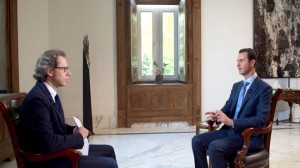
Damascus, SANA-President Bashar al-Assad gave an interview to Italian TV channel RAI UNO,
Following is the full text;
Question 1: Mr. President, thanks for the opportunity of talking to you. Let’s start from Paris. How did you react to the news coming from Paris?
President Assad: We can start by saying it’s a horrible crime, and at the same time it’s a sad event when you hear about innocents being killed without any reason and for nothing, and we understand in Syria the meaning of losing a dear member of the family or a dear friend, or anyone you know, in such a horrible crime. We’ve been suffering from that for the past five years. We feel for the French as we feel for the Lebanese a few days before that, and for the Russians regarding the airplane that’s been shot down over Sinai, and for the Yemenis maybe, but does the world, especially the West, feel for those people, or only for the French? Do they feel for the Syrians that have been suffering for five years from the same kind of terrorism? We cannot politicize feeling, feeling is not about the nationality, it’s about the human in general.
Question 2: There’s Daesh behind that. But from here, from this point of view, from here from Damascus, how strong Daesh is? How do you think we can fight terrorists on the ground?
President al-Assad: ISIS has no incubator in Syria
President Assad: If you want to talk about the strength of Daesh, the first thing you have to ask is how much incubator, real incubator, natural incubator, you have in a certain society. Till this moment, I can tell you Daesh doesn’t have the natural incubator, social incubator, within Syria. This is something very good and very assuring, but at the same time, if it’s becoming chronic, this kind of ideology can change the society.
Question 3: Yes, but some of the terrorists were trained here, in Syria, just a few kilometers from here. What does it mean?
President Assad: That’s by the support of the Turks and the Saudi and Qatari and of course the Western policy that supported the terrorists in different ways since the beginning of the crisis, of course, but that’s not the issue. First of all, if you don’t have the incubator, you shouldn’t worry, but second, they can be strong as long as they have strong support from different states, whether Middle Eastern states or Western states.
Question 4: Mr. President, there are speculations in the West, that say that you were one of who supported Daesh in the beginning of the crisis, because of dividing the opposition, because of dividing the rebels. How do you react?
President al-Assad:Al Qaeda was created by the Americans
President Assad: Actually, according to what some American officials said, including Hillary Clinton, Al Qaeda was created by the Americans with the help of Saudi Wahabi money and ideology, and of course, many other officials said the same in the United States. And ISIS and al-Nusra, they are offshoots of Al Qaeda. Regarding ISIS, it started in Iraq, it was established in Iraq in 2006, and the leader was al-Zarqawi who was killed by the American forces then, so it was established under the American supervision in Iraq, and the leader of ISIS today, who is called Abu Bakr al-Baghdadi, he was in the American prisons, and he was put in New York in their prisons, and he was released by them. So, it wasn’t in Syria, it didn’t start in Syria, it started in Iraq, and it started before that in Afghanistan according to what they said, and Tony Blair recently said that yes, the Iraqi war helped create ISIS. So, their confession is the most important evidence regarding your question.
Question 5: Mr. President, watching the map of Syria, it seems that Syrian-Iraqi borders doesn’t exist anymore. Which part of Syria do you really control at the moment?
 President Assad: If you’re talking geographically, it’s changing every day, but the most important thing is how much of the population are under the government’s control. Actually, most of the area that’s being controlled by the terrorists has been evacuated either by the terrorists, or because the people fled to the government control. There’s the question of how much of the Syrian population still supports the government? Militarily, you can win ground, you can lose some area, but anyway the army cannot exist everywhere in Syria. But looking to the map that you described, and what I see from time to time in the Western media, when they show you that the government controls 50% or less of their ground, actually 50 or 60% of Syria is empty ground, where you don’t have anyone, so they put it under the control of the terrorists, while it’s empty, fully empty.
Question 6: Yes, I spoke about the borders between Syria and Iraq.
President Assad: Exactly. After Damascus toward Iraq, it’s empty space, it’s empty area, so you cannot talk about its control. But regarding the borders, it’s only related to the terrorists; it’s related to the governments that supported the terrorists like the Turkish government first of all, and the Jordanian government. Both governments support terrorists, that’s why you have loose borders, because when you want to have controlled borders, it needs to be controlled from both sides, not from one sides.
Question 7:Well, the last weekend there have been two very important meetings talking about the situation in Syria, in Vienna and in Antalya. Most countries are talking about the transition in Syria. There are different positions, but basically most of the countries agree with the idea of elections in 18 months. But they also say that in the meantime, basically, you should leave. What’s your position about that?
President al-Assad: The main part of Vienna statement is that everything regarding the political process is about what the Syrians are going to agree upon
President Assad:No, in the statement there is nothing regarding the president. The main part of Vienna is that everything that is going to happen regarding the political process is about what the Syrians are going to agree upon, so the most output of that phrase is about the constitution, and the president, any president, should come to his position and leave that position according to constitutional procedures, not to the opinion of any Western power or country. So, as long as you are talking about the consensus of the Syrians, forget about the rest of Vienna. Regarding the schedule, that depends on the agreement that we can reach as Syrians. If we don’t reach it in 18 months, so what? You have many things that I think are trivial now, or let’s say, not essential. The most important part is that we’re going to sit with each other then we’re going to put our schedule and our plan as Syrians.
Question 8: I understand, but do you consider it an option, the possibility to leave power? I mean, do you imagine an electoral process without you?
President Assad: It depends. What do you mean by electoral? Do you mean at the parliament or the president?
Question 9:At the parliament.
President Assad:At the parliament, of course, there’s going to be parliamentarian elections because the parliamentarian elections is going to show which power of the political powers in Syria has real weight among the Syrian people, which one has real grassroots. Now, anyone can say “I’m opposition.” What does it mean, how do you translate it? Through the elections, and the seat that they can get in the parliament will tell how much they can have in the coming government, for example. Of course, that will be after having a new constitution. I’m just putting a proposal, for example, now, I’m not giving you the thing that we have agreed upon yet.
Question 10:And about the presidential [elections]?
President Assad: The presidential… if the Syrians, in their dialogue, they wanted to have presidential elections, there’s nothing called a red line, for example, regarding this. But it’s not my decision. It should be about what the consensus is among the Syrians.
Question 11:But, there could be someone else that you trust, participating in the process of elections instead of you.
President Assad:Someone I trust? What do you mean by someone I trust?
Question 12:I mean someone else in which you trust that can make this job.
President Assad: [laughs] Yeah, but it looks like talking about my private property, so I can go and bring someone to put in my place. It’s not a private property; it’s a national issue. A national issue, only the Syrians can choose someone they trust. Doesn’t matter if I trust someone or not. Whoever the Syrians trust will be in that position.
President al-Assad: Terrorists are main obstacle of any real political advancement
Question 13:Let me see if I understood well. Which is the real timetable, which is exactly your timetable, I mean the realistic timetable to get out of this crisis?
President Assad: The timetable, if you want to talk about schedule, this timetable starts after starting defeating terrorism. Before that, there will be no point in deciding any timetable, because you cannot achieve anything politically while you have the terrorists taking over many areas in Syria, and they’re going to be – they are already they main obstacle of any real political advancement. If we talk after that, one year and a half to two years is enough for any transition. It’s enough. I mean if you want to talk about first of all having a new constitution, then referendum, then parliamentarian elections, then any kind of other procedure, whether presidential or any other thing, doesn’t matter. It won’t take more than two years.
Question 14:There’s something else about the opposition; in these years, you said that you couldn’t consider as an opposition those who are fighting. Did you change your mind?
President Assad: We can apply that to your country; you don’t accept any opposition that are holding machineguns in your country. That’s the case in every other country. Whoever holds a machinegun and terrorizes people and destroys private or public properties or kills innocents and whoever is a terrorist, he’s not opposition. Opposition is a political term. Opposition could be defined not through your own opinion; it could be defined only through the elections, through the ballot box.
Question 15:So what do you consider opposition at the moment? Political opposition?
President Assad: I mean, ask the Syrians who they consider opposition. If they elect them, they are the real opposition. So that’s why I said we can define, we can give definition to this after the elections. But if you want to talk about my own opinion, you can be opposition when you have Syrian grassroots, when you belong only to your country. You cannot be opposition while you are formed as person or as entity in the foreign ministry of another country or in the intelligence building of other countries. You cannot be a puppet, you cannot be a surrogate mercenary; you can only be a real Syrian.
President al-Assad: Every Syrian citizen who leaves this country, is a loss to Syria
Question 16:Now in Europe, in Italy, we see so many Syrians coming, Syrian refugees, they are refugees. What would you like to tell these fleeing people, to you escaping people?
President Assad: Of course I would say everyone who leaves this country, is a loss to Syria. That’s for sure, and we feel sad, we feel the suffering, because every refugee in Syria has a long story of suffering within Syria, and that’s what we should deal with by asking the question “why did they leave?” For many reasons. The first one, the direct threat by terrorists. The second one is the influence of terrorists in destroying many of the infrastructure and affecting the livelihood of those people. But the third one, which is as important as the influence of terrorists, is the Western embargo on Syria. Many of those, if you ask him “do you want to go back to Syria” he wants to go back right away, but how can he go back to Syria while the basics of his life, his livelihood, has been affected dramatically, so he cannot stay in Syria. The embargo influence of the West and the terrorist influence has put those people between the devil and the deep blue sea.
Question 17:But don’t you feel in any way responsible for what has happened to your people?
President Assad: You mean myself?
Question 18: Yes.
President Assad:The only thing that we did since the beginning of the crisis is fighting terrorism and supporting dialogue. What else can we do? Does anyone oppose the dialogue? Does anyone oppose fighting terrorism? If you want to talk about the details, and about propaganda in the West, we shouldn’t waste our time. It’s just propaganda, because the problem from the very beginning with the West is that they don’t need this president, they want this government to fail and collapse, so they can change it. Everybody knows that. The whole Western game is regime-change, regardless of the meaning of regime; we don’t have a regime, we have a state, but I’m talking about their concept and their principle. So, you can blame whoever you want, but the main blame is on the West who supported those terrorists who created ISIS in Syria and created al-Nusra because of the umbrella that they gave to those terrorist organizations.
Question 19:So no responsibility?
President Assad: Of course, as a Syrian, no, I’m not saying that we don’t do mistakes. You have mistakes on the tactical level that you do every day in your work, and you have strategies. And the strategies, we adopted these two approaches, but on the tactical level, you do many mistakes every day. Every Syrian is responsible for what happened. We are responsible as Syrians, when we allow these terrorists to come to Syria, because of some Syrians who have the same mentality, and some Syrians who accepted to be puppets to the Gulf states and to the West. Of course we’re taking responsibility, while if you want to talk about my responsibility, it’s something you talk about details. I mean it’s difficult to judge now.
Question 20:I would like to ask you: how was your trip to Moscow?
President Assad: It was a trip to discuss the military situation, because it happened nearly two weeks after the Russians started the airstrikes, and to discuss the political process, because it was, again, a few days before Vienna 1. It was very fruitful, because the Russians understand very well this region, because they have historical relations, they have embassies, they have all kinds of necessary relations and means to play a role. So, I can describe it by fruitful visit.
Question 21: From Rome, from the Vatican, the Pope said that killing in the name of God is a blasphemy. And the question, first of all, is this war really a war of religion?
President Assad: No, actually, no. It’s not a religious war. It’s between people who deviated from the real religion, mainly of course, Islam, towards extremism, which we don’t consider as part of our religion. It’s a war between the real Muslims and the other extremists. This is the core of the war today. Of course, they give it different titles; war against Christians, war about other sects. This is only headlines the extremists use to promote their war, but the real issue is the war between them and the rest of the Muslims, the majority who are mainly moderate.
Question 22: Even if they kill in the name of God? They kill saying Allah Akbar?
President Assad: Exactly, that’s how they can promote their war. That’s why they use these holy words or phrase, in order to convince the other simple people in this region that they are fighting for Allah, for God, which is not true. And some of them, they use it with knowing that this is not true, and some of them are ignorant and they believe that this is a war for God. That’s the deviation, that’s why I said it’s a deviation; they are people who deviated from real Islam with knowing or without knowing.
Question 23: And what about the future of Christian people in Syria, in your country?
President Assad: Actually, this region, I think most of the Italians and many in the West know that this is a moderate region, a moderate society, especially Syria, whether politically or socially and culturally, and the main reason why we have this moderation is because we have this diversity in sects and ethnicities. But one of the most important factors is the Christian factor in the history of Syria, especially after Islam came to this region14 centuriesago. So, without them, this region will move more toward extremism. So, their future is important, but you cannot separate it from the future of the Syrians, it’s not separated. I mean, if you have a good future for the Syrians, the future of every component of our society will be good, and vice versa.
Question 24: Okay, so there’s a future for them here, because there seems to be a target in this war on Christian people.
President Assad:Not really, actually the number of Muslims that have been killed in Syria is much, much more than the Christians, so you cannot say there’s a target. Again, it’s only used by the extremists in order to promote their war, that it’s against the “atheists” and it’s for God and so on, but in reality, no.
Question 25:Mr. President, before the end of this interview, let me ask you one more question. How do you see your future? Do you consider the more important the future of Syria, or you staying in power?
President Assad: It’s self-evident; the future of Syria is everything for us. I mean, even my future cannot be separate, as a citizen. As a citizen, if my country is not safe, I cannot be safe. If it’s not good, I cannot have a good future, so that’s self-evident. But again, if you want to put them against each other, it’s like saying “if the president is here, the future of Syria is bad. If the president leaves, the future of Syria is good.” That’s the Western propaganda. Actually, that’s not the case within Syria. Within Syria, you have people who support that president, you have people who don’t support that president, so when my future is good for Syria, if the Syrian people want me as president, the future will be good. If the Syrian people don’t want me, and I want to cling to power, this is where for me being as president is bad. So it’s very simple. So, we don’t have to follow the Western propaganda to answer according to that propaganda, because it’s disconnected from reality. I have to answer you according to our reality.
Journalist:Okay, thank you, Mr. President. Thank for this opportunity.
President Assad: If you’re talking geographically, it’s changing every day, but the most important thing is how much of the population are under the government’s control. Actually, most of the area that’s being controlled by the terrorists has been evacuated either by the terrorists, or because the people fled to the government control. There’s the question of how much of the Syrian population still supports the government? Militarily, you can win ground, you can lose some area, but anyway the army cannot exist everywhere in Syria. But looking to the map that you described, and what I see from time to time in the Western media, when they show you that the government controls 50% or less of their ground, actually 50 or 60% of Syria is empty ground, where you don’t have anyone, so they put it under the control of the terrorists, while it’s empty, fully empty.
Question 6: Yes, I spoke about the borders between Syria and Iraq.
President Assad: Exactly. After Damascus toward Iraq, it’s empty space, it’s empty area, so you cannot talk about its control. But regarding the borders, it’s only related to the terrorists; it’s related to the governments that supported the terrorists like the Turkish government first of all, and the Jordanian government. Both governments support terrorists, that’s why you have loose borders, because when you want to have controlled borders, it needs to be controlled from both sides, not from one sides.
Question 7:Well, the last weekend there have been two very important meetings talking about the situation in Syria, in Vienna and in Antalya. Most countries are talking about the transition in Syria. There are different positions, but basically most of the countries agree with the idea of elections in 18 months. But they also say that in the meantime, basically, you should leave. What’s your position about that?
President al-Assad: The main part of Vienna statement is that everything regarding the political process is about what the Syrians are going to agree upon
President Assad:No, in the statement there is nothing regarding the president. The main part of Vienna is that everything that is going to happen regarding the political process is about what the Syrians are going to agree upon, so the most output of that phrase is about the constitution, and the president, any president, should come to his position and leave that position according to constitutional procedures, not to the opinion of any Western power or country. So, as long as you are talking about the consensus of the Syrians, forget about the rest of Vienna. Regarding the schedule, that depends on the agreement that we can reach as Syrians. If we don’t reach it in 18 months, so what? You have many things that I think are trivial now, or let’s say, not essential. The most important part is that we’re going to sit with each other then we’re going to put our schedule and our plan as Syrians.
Question 8: I understand, but do you consider it an option, the possibility to leave power? I mean, do you imagine an electoral process without you?
President Assad: It depends. What do you mean by electoral? Do you mean at the parliament or the president?
Question 9:At the parliament.
President Assad:At the parliament, of course, there’s going to be parliamentarian elections because the parliamentarian elections is going to show which power of the political powers in Syria has real weight among the Syrian people, which one has real grassroots. Now, anyone can say “I’m opposition.” What does it mean, how do you translate it? Through the elections, and the seat that they can get in the parliament will tell how much they can have in the coming government, for example. Of course, that will be after having a new constitution. I’m just putting a proposal, for example, now, I’m not giving you the thing that we have agreed upon yet.
Question 10:And about the presidential [elections]?
President Assad: The presidential… if the Syrians, in their dialogue, they wanted to have presidential elections, there’s nothing called a red line, for example, regarding this. But it’s not my decision. It should be about what the consensus is among the Syrians.
Question 11:But, there could be someone else that you trust, participating in the process of elections instead of you.
President Assad:Someone I trust? What do you mean by someone I trust?
Question 12:I mean someone else in which you trust that can make this job.
President Assad: [laughs] Yeah, but it looks like talking about my private property, so I can go and bring someone to put in my place. It’s not a private property; it’s a national issue. A national issue, only the Syrians can choose someone they trust. Doesn’t matter if I trust someone or not. Whoever the Syrians trust will be in that position.
President al-Assad: Terrorists are main obstacle of any real political advancement
Question 13:Let me see if I understood well. Which is the real timetable, which is exactly your timetable, I mean the realistic timetable to get out of this crisis?
President Assad: The timetable, if you want to talk about schedule, this timetable starts after starting defeating terrorism. Before that, there will be no point in deciding any timetable, because you cannot achieve anything politically while you have the terrorists taking over many areas in Syria, and they’re going to be – they are already they main obstacle of any real political advancement. If we talk after that, one year and a half to two years is enough for any transition. It’s enough. I mean if you want to talk about first of all having a new constitution, then referendum, then parliamentarian elections, then any kind of other procedure, whether presidential or any other thing, doesn’t matter. It won’t take more than two years.
Question 14:There’s something else about the opposition; in these years, you said that you couldn’t consider as an opposition those who are fighting. Did you change your mind?
President Assad: We can apply that to your country; you don’t accept any opposition that are holding machineguns in your country. That’s the case in every other country. Whoever holds a machinegun and terrorizes people and destroys private or public properties or kills innocents and whoever is a terrorist, he’s not opposition. Opposition is a political term. Opposition could be defined not through your own opinion; it could be defined only through the elections, through the ballot box.
Question 15:So what do you consider opposition at the moment? Political opposition?
President Assad: I mean, ask the Syrians who they consider opposition. If they elect them, they are the real opposition. So that’s why I said we can define, we can give definition to this after the elections. But if you want to talk about my own opinion, you can be opposition when you have Syrian grassroots, when you belong only to your country. You cannot be opposition while you are formed as person or as entity in the foreign ministry of another country or in the intelligence building of other countries. You cannot be a puppet, you cannot be a surrogate mercenary; you can only be a real Syrian.
President al-Assad: Every Syrian citizen who leaves this country, is a loss to Syria
Question 16:Now in Europe, in Italy, we see so many Syrians coming, Syrian refugees, they are refugees. What would you like to tell these fleeing people, to you escaping people?
President Assad: Of course I would say everyone who leaves this country, is a loss to Syria. That’s for sure, and we feel sad, we feel the suffering, because every refugee in Syria has a long story of suffering within Syria, and that’s what we should deal with by asking the question “why did they leave?” For many reasons. The first one, the direct threat by terrorists. The second one is the influence of terrorists in destroying many of the infrastructure and affecting the livelihood of those people. But the third one, which is as important as the influence of terrorists, is the Western embargo on Syria. Many of those, if you ask him “do you want to go back to Syria” he wants to go back right away, but how can he go back to Syria while the basics of his life, his livelihood, has been affected dramatically, so he cannot stay in Syria. The embargo influence of the West and the terrorist influence has put those people between the devil and the deep blue sea.
Question 17:But don’t you feel in any way responsible for what has happened to your people?
President Assad: You mean myself?
Question 18: Yes.
President Assad:The only thing that we did since the beginning of the crisis is fighting terrorism and supporting dialogue. What else can we do? Does anyone oppose the dialogue? Does anyone oppose fighting terrorism? If you want to talk about the details, and about propaganda in the West, we shouldn’t waste our time. It’s just propaganda, because the problem from the very beginning with the West is that they don’t need this president, they want this government to fail and collapse, so they can change it. Everybody knows that. The whole Western game is regime-change, regardless of the meaning of regime; we don’t have a regime, we have a state, but I’m talking about their concept and their principle. So, you can blame whoever you want, but the main blame is on the West who supported those terrorists who created ISIS in Syria and created al-Nusra because of the umbrella that they gave to those terrorist organizations.
Question 19:So no responsibility?
President Assad: Of course, as a Syrian, no, I’m not saying that we don’t do mistakes. You have mistakes on the tactical level that you do every day in your work, and you have strategies. And the strategies, we adopted these two approaches, but on the tactical level, you do many mistakes every day. Every Syrian is responsible for what happened. We are responsible as Syrians, when we allow these terrorists to come to Syria, because of some Syrians who have the same mentality, and some Syrians who accepted to be puppets to the Gulf states and to the West. Of course we’re taking responsibility, while if you want to talk about my responsibility, it’s something you talk about details. I mean it’s difficult to judge now.
Question 20:I would like to ask you: how was your trip to Moscow?
President Assad: It was a trip to discuss the military situation, because it happened nearly two weeks after the Russians started the airstrikes, and to discuss the political process, because it was, again, a few days before Vienna 1. It was very fruitful, because the Russians understand very well this region, because they have historical relations, they have embassies, they have all kinds of necessary relations and means to play a role. So, I can describe it by fruitful visit.
Question 21: From Rome, from the Vatican, the Pope said that killing in the name of God is a blasphemy. And the question, first of all, is this war really a war of religion?
President Assad: No, actually, no. It’s not a religious war. It’s between people who deviated from the real religion, mainly of course, Islam, towards extremism, which we don’t consider as part of our religion. It’s a war between the real Muslims and the other extremists. This is the core of the war today. Of course, they give it different titles; war against Christians, war about other sects. This is only headlines the extremists use to promote their war, but the real issue is the war between them and the rest of the Muslims, the majority who are mainly moderate.
Question 22: Even if they kill in the name of God? They kill saying Allah Akbar?
President Assad: Exactly, that’s how they can promote their war. That’s why they use these holy words or phrase, in order to convince the other simple people in this region that they are fighting for Allah, for God, which is not true. And some of them, they use it with knowing that this is not true, and some of them are ignorant and they believe that this is a war for God. That’s the deviation, that’s why I said it’s a deviation; they are people who deviated from real Islam with knowing or without knowing.
Question 23: And what about the future of Christian people in Syria, in your country?
President Assad: Actually, this region, I think most of the Italians and many in the West know that this is a moderate region, a moderate society, especially Syria, whether politically or socially and culturally, and the main reason why we have this moderation is because we have this diversity in sects and ethnicities. But one of the most important factors is the Christian factor in the history of Syria, especially after Islam came to this region14 centuriesago. So, without them, this region will move more toward extremism. So, their future is important, but you cannot separate it from the future of the Syrians, it’s not separated. I mean, if you have a good future for the Syrians, the future of every component of our society will be good, and vice versa.
Question 24: Okay, so there’s a future for them here, because there seems to be a target in this war on Christian people.
President Assad:Not really, actually the number of Muslims that have been killed in Syria is much, much more than the Christians, so you cannot say there’s a target. Again, it’s only used by the extremists in order to promote their war, that it’s against the “atheists” and it’s for God and so on, but in reality, no.
Question 25:Mr. President, before the end of this interview, let me ask you one more question. How do you see your future? Do you consider the more important the future of Syria, or you staying in power?
President Assad: It’s self-evident; the future of Syria is everything for us. I mean, even my future cannot be separate, as a citizen. As a citizen, if my country is not safe, I cannot be safe. If it’s not good, I cannot have a good future, so that’s self-evident. But again, if you want to put them against each other, it’s like saying “if the president is here, the future of Syria is bad. If the president leaves, the future of Syria is good.” That’s the Western propaganda. Actually, that’s not the case within Syria. Within Syria, you have people who support that president, you have people who don’t support that president, so when my future is good for Syria, if the Syrian people want me as president, the future will be good. If the Syrian people don’t want me, and I want to cling to power, this is where for me being as president is bad. So it’s very simple. So, we don’t have to follow the Western propaganda to answer according to that propaganda, because it’s disconnected from reality. I have to answer you according to our reality.
Journalist:Okay, thank you, Mr. President. Thank for this opportunity.

19 November، 2015
Damascus, SANA-President Bashar al-Assad gave an interview to Italian TV channel RAI UNO,
Following is the full text;
Question 1: Mr. President, thanks for the opportunity of talking to you. Let’s start from Paris. How did you react to the news coming from Paris?
President Assad: We can start by saying it’s a horrible crime, and at the same time it’s a sad event when you hear about innocents being killed without any reason and for nothing, and we understand in Syria the meaning of losing a dear member of the family or a dear friend, or anyone you know, in such a horrible crime. We’ve been suffering from that for the past five years. We feel for the French as we feel for the Lebanese a few days before that, and for the Russians regarding the airplane that’s been shot down over Sinai, and for the Yemenis maybe, but does the world, especially the West, feel for those people, or only for the French? Do they feel for the Syrians that have been suffering for five years from the same kind of terrorism? We cannot politicize feeling, feeling is not about the nationality, it’s about the human in general.
Question 2: There’s Daesh behind that. But from here, from this point of view, from here from Damascus, how strong Daesh is? How do you think we can fight terrorists on the ground?
President al-Assad: ISIS has no incubator in Syria
President Assad: If you want to talk about the strength of Daesh, the first thing you have to ask is how much incubator, real incubator, natural incubator, you have in a certain society. Till this moment, I can tell you Daesh doesn’t have the natural incubator, social incubator, within Syria. This is something very good and very assuring, but at the same time, if it’s becoming chronic, this kind of ideology can change the society.
Question 3: Yes, but some of the terrorists were trained here, in Syria, just a few kilometers from here. What does it mean?
President Assad: That’s by the support of the Turks and the Saudi and Qatari and of course the Western policy that supported the terrorists in different ways since the beginning of the crisis, of course, but that’s not the issue. First of all, if you don’t have the incubator, you shouldn’t worry, but second, they can be strong as long as they have strong support from different states, whether Middle Eastern states or Western states.
Question 4: Mr. President, there are speculations in the West, that say that you were one of who supported Daesh in the beginning of the crisis, because of dividing the opposition, because of dividing the rebels. How do you react?
President al-Assad:Al Qaeda was created by the Americans
President Assad: Actually, according to what some American officials said, including Hillary Clinton, Al Qaeda was created by the Americans with the help of Saudi Wahabi money and ideology, and of course, many other officials said the same in the United States. And ISIS and al-Nusra, they are offshoots of Al Qaeda. Regarding ISIS, it started in Iraq, it was established in Iraq in 2006, and the leader was al-Zarqawi who was killed by the American forces then, so it was established under the American supervision in Iraq, and the leader of ISIS today, who is called Abu Bakr al-Baghdadi, he was in the American prisons, and he was put in New York in their prisons, and he was released by them. So, it wasn’t in Syria, it didn’t start in Syria, it started in Iraq, and it started before that in Afghanistan according to what they said, and Tony Blair recently said that yes, the Iraqi war helped create ISIS. So, their confession is the most important evidence regarding your question.
Question 5: Mr. President, watching the map of Syria, it seems that Syrian-Iraqi borders doesn’t exist anymore. Which part of Syria do you really control at the moment?
President Assad: If you’re talking geographically, it’s changing every day, but the most important thing is how much of the population are under the government’s control. Actually, most of the area that’s being controlled by the terrorists has been evacuated either by the terrorists, or because the people fled to the government control. There’s the question of how much of the Syrian population still supports the government? Militarily, you can win ground, you can lose some area, but anyway the army cannot exist everywhere in Syria. But looking to the map that you described, and what I see from time to time in the Western media, when they show you that the government controls 50% or less of their ground, actually 50 or 60% of Syria is empty ground, where you don’t have anyone, so they put it under the control of the terrorists, while it’s empty, fully empty.
Question 6: Yes, I spoke about the borders between Syria and Iraq.
President Assad: Exactly. After Damascus toward Iraq, it’s empty space, it’s empty area, so you cannot talk about its control. But regarding the borders, it’s only related to the terrorists; it’s related to the governments that supported the terrorists like the Turkish government first of all, and the Jordanian government. Both governments support terrorists, that’s why you have loose borders, because when you want to have controlled borders, it needs to be controlled from both sides, not from one sides.
Question 7:Well, the last weekend there have been two very important meetings talking about the situation in Syria, in Vienna and in Antalya. Most countries are talking about the transition in Syria. There are different positions, but basically most of the countries agree with the idea of elections in 18 months. But they also say that in the meantime, basically, you should leave. What’s your position about that?
President al-Assad: The main part of Vienna statement is that everything regarding the political process is about what the Syrians are going to agree upon
President Assad:No, in the statement there is nothing regarding the president. The main part of Vienna is that everything that is going to happen regarding the political process is about what the Syrians are going to agree upon, so the most output of that phrase is about the constitution, and the president, any president, should come to his position and leave that position according to constitutional procedures, not to the opinion of any Western power or country. So, as long as you are talking about the consensus of the Syrians, forget about the rest of Vienna. Regarding the schedule, that depends on the agreement that we can reach as Syrians. If we don’t reach it in 18 months, so what? You have many things that I think are trivial now, or let’s say, not essential. The most important part is that we’re going to sit with each other then we’re going to put our schedule and our plan as Syrians.
Question 8: I understand, but do you consider it an option, the possibility to leave power? I mean, do you imagine an electoral process without you?
President Assad: It depends. What do you mean by electoral? Do you mean at the parliament or the president?
Question 9:At the parliament.
President Assad:At the parliament, of course, there’s going to be parliamentarian elections because the parliamentarian elections is going to show which power of the political powers in Syria has real weight among the Syrian people, which one has real grassroots. Now, anyone can say “I’m opposition.” What does it mean, how do you translate it? Through the elections, and the seat that they can get in the parliament will tell how much they can have in the coming government, for example. Of course, that will be after having a new constitution. I’m just putting a proposal, for example, now, I’m not giving you the thing that we have agreed upon yet.
Question 10:And about the presidential [elections]?
President Assad: The presidential… if the Syrians, in their dialogue, they wanted to have presidential elections, there’s nothing called a red line, for example, regarding this. But it’s not my decision. It should be about what the consensus is among the Syrians.
Question 11:But, there could be someone else that you trust, participating in the process of elections instead of you.
President Assad:Someone I trust? What do you mean by someone I trust?
Question 12:I mean someone else in which you trust that can make this job.
President Assad: [laughs] Yeah, but it looks like talking about my private property, so I can go and bring someone to put in my place. It’s not a private property; it’s a national issue. A national issue, only the Syrians can choose someone they trust. Doesn’t matter if I trust someone or not. Whoever the Syrians trust will be in that position.
President al-Assad: Terrorists are main obstacle of any real political advancement
Question 13:Let me see if I understood well. Which is the real timetable, which is exactly your timetable, I mean the realistic timetable to get out of this crisis?
President Assad: The timetable, if you want to talk about schedule, this timetable starts after starting defeating terrorism. Before that, there will be no point in deciding any timetable, because you cannot achieve anything politically while you have the terrorists taking over many areas in Syria, and they’re going to be – they are already they main obstacle of any real political advancement. If we talk after that, one year and a half to two years is enough for any transition. It’s enough. I mean if you want to talk about first of all having a new constitution, then referendum, then parliamentarian elections, then any kind of other procedure, whether presidential or any other thing, doesn’t matter. It won’t take more than two years.
Question 14:There’s something else about the opposition; in these years, you said that you couldn’t consider as an opposition those who are fighting. Did you change your mind?
President Assad: We can apply that to your country; you don’t accept any opposition that are holding machineguns in your country. That’s the case in every other country. Whoever holds a machinegun and terrorizes people and destroys private or public properties or kills innocents and whoever is a terrorist, he’s not opposition. Opposition is a political term. Opposition could be defined not through your own opinion; it could be defined only through the elections, through the ballot box.
Question 15:So what do you consider opposition at the moment? Political opposition?
President Assad: I mean, ask the Syrians who they consider opposition. If they elect them, they are the real opposition. So that’s why I said we can define, we can give definition to this after the elections. But if you want to talk about my own opinion, you can be opposition when you have Syrian grassroots, when you belong only to your country. You cannot be opposition while you are formed as person or as entity in the foreign ministry of another country or in the intelligence building of other countries. You cannot be a puppet, you cannot be a surrogate mercenary; you can only be a real Syrian.
President al-Assad: Every Syrian citizen who leaves this country, is a loss to Syria
Question 16:Now in Europe, in Italy, we see so many Syrians coming, Syrian refugees, they are refugees. What would you like to tell these fleeing people, to you escaping people?
President Assad: Of course I would say everyone who leaves this country, is a loss to Syria. That’s for sure, and we feel sad, we feel the suffering, because every refugee in Syria has a long story of suffering within Syria, and that’s what we should deal with by asking the question “why did they leave?” For many reasons. The first one, the direct threat by terrorists. The second one is the influence of terrorists in destroying many of the infrastructure and affecting the livelihood of those people. But the third one, which is as important as the influence of terrorists, is the Western embargo on Syria. Many of those, if you ask him “do you want to go back to Syria” he wants to go back right away, but how can he go back to Syria while the basics of his life, his livelihood, has been affected dramatically, so he cannot stay in Syria. The embargo influence of the West and the terrorist influence has put those people between the devil and the deep blue sea.
Question 17:But don’t you feel in any way responsible for what has happened to your people?
President Assad: You mean myself?
Question 18: Yes.
President Assad:The only thing that we did since the beginning of the crisis is fighting terrorism and supporting dialogue. What else can we do? Does anyone oppose the dialogue? Does anyone oppose fighting terrorism? If you want to talk about the details, and about propaganda in the West, we shouldn’t waste our time. It’s just propaganda, because the problem from the very beginning with the West is that they don’t need this president, they want this government to fail and collapse, so they can change it. Everybody knows that. The whole Western game is regime-change, regardless of the meaning of regime; we don’t have a regime, we have a state, but I’m talking about their concept and their principle. So, you can blame whoever you want, but the main blame is on the West who supported those terrorists who created ISIS in Syria and created al-Nusra because of the umbrella that they gave to those terrorist organizations.
Question 19:So no responsibility?
President Assad: Of course, as a Syrian, no, I’m not saying that we don’t do mistakes. You have mistakes on the tactical level that you do every day in your work, and you have strategies. And the strategies, we adopted these two approaches, but on the tactical level, you do many mistakes every day. Every Syrian is responsible for what happened. We are responsible as Syrians, when we allow these terrorists to come to Syria, because of some Syrians who have the same mentality, and some Syrians who accepted to be puppets to the Gulf states and to the West. Of course we’re taking responsibility, while if you want to talk about my responsibility, it’s something you talk about details. I mean it’s difficult to judge now.
Question 20:I would like to ask you: how was your trip to Moscow?
President Assad: It was a trip to discuss the military situation, because it happened nearly two weeks after the Russians started the airstrikes, and to discuss the political process, because it was, again, a few days before Vienna 1. It was very fruitful, because the Russians understand very well this region, because they have historical relations, they have embassies, they have all kinds of necessary relations and means to play a role. So, I can describe it by fruitful visit.
Question 21: From Rome, from the Vatican, the Pope said that killing in the name of God is a blasphemy. And the question, first of all, is this war really a war of religion?
President Assad: No, actually, no. It’s not a religious war. It’s between people who deviated from the real religion, mainly of course, Islam, towards extremism, which we don’t consider as part of our religion. It’s a war between the real Muslims and the other extremists. This is the core of the war today. Of course, they give it different titles; war against Christians, war about other sects. This is only headlines the extremists use to promote their war, but the real issue is the war between them and the rest of the Muslims, the majority who are mainly moderate.
Question 22: Even if they kill in the name of God? They kill saying Allah Akbar?
President Assad: Exactly, that’s how they can promote their war. That’s why they use these holy words or phrase, in order to convince the other simple people in this region that they are fighting for Allah, for God, which is not true. And some of them, they use it with knowing that this is not true, and some of them are ignorant and they believe that this is a war for God. That’s the deviation, that’s why I said it’s a deviation; they are people who deviated from real Islam with knowing or without knowing.
Question 23: And what about the future of Christian people in Syria, in your country?
President Assad: Actually, this region, I think most of the Italians and many in the West know that this is a moderate region, a moderate society, especially Syria, whether politically or socially and culturally, and the main reason why we have this moderation is because we have this diversity in sects and ethnicities. But one of the most important factors is the Christian factor in the history of Syria, especially after Islam came to this region14 centuriesago. So, without them, this region will move more toward extremism. So, their future is important, but you cannot separate it from the future of the Syrians, it’s not separated. I mean, if you have a good future for the Syrians, the future of every component of our society will be good, and vice versa.
Question 24: Okay, so there’s a future for them here, because there seems to be a target in this war on Christian people.
President Assad:Not really, actually the number of Muslims that have been killed in Syria is much, much more than the Christians, so you cannot say there’s a target. Again, it’s only used by the extremists in order to promote their war, that it’s against the “atheists” and it’s for God and so on, but in reality, no.
Question 25:Mr. President, before the end of this interview, let me ask you one more question. How do you see your future? Do you consider the more important the future of Syria, or you staying in power?
President Assad: It’s self-evident; the future of Syria is everything for us. I mean, even my future cannot be separate, as a citizen. As a citizen, if my country is not safe, I cannot be safe. If it’s not good, I cannot have a good future, so that’s self-evident. But again, if you want to put them against each other, it’s like saying “if the president is here, the future of Syria is bad. If the president leaves, the future of Syria is good.” That’s the Western propaganda. Actually, that’s not the case within Syria. Within Syria, you have people who support that president, you have people who don’t support that president, so when my future is good for Syria, if the Syrian people want me as president, the future will be good. If the Syrian people don’t want me, and I want to cling to power, this is where for me being as president is bad. So it’s very simple. So, we don’t have to follow the Western propaganda to answer according to that propaganda, because it’s disconnected from reality. I have to answer you according to our reality.
Journalist:Okay, thank you, Mr. President. Thank for this opportunity.


